
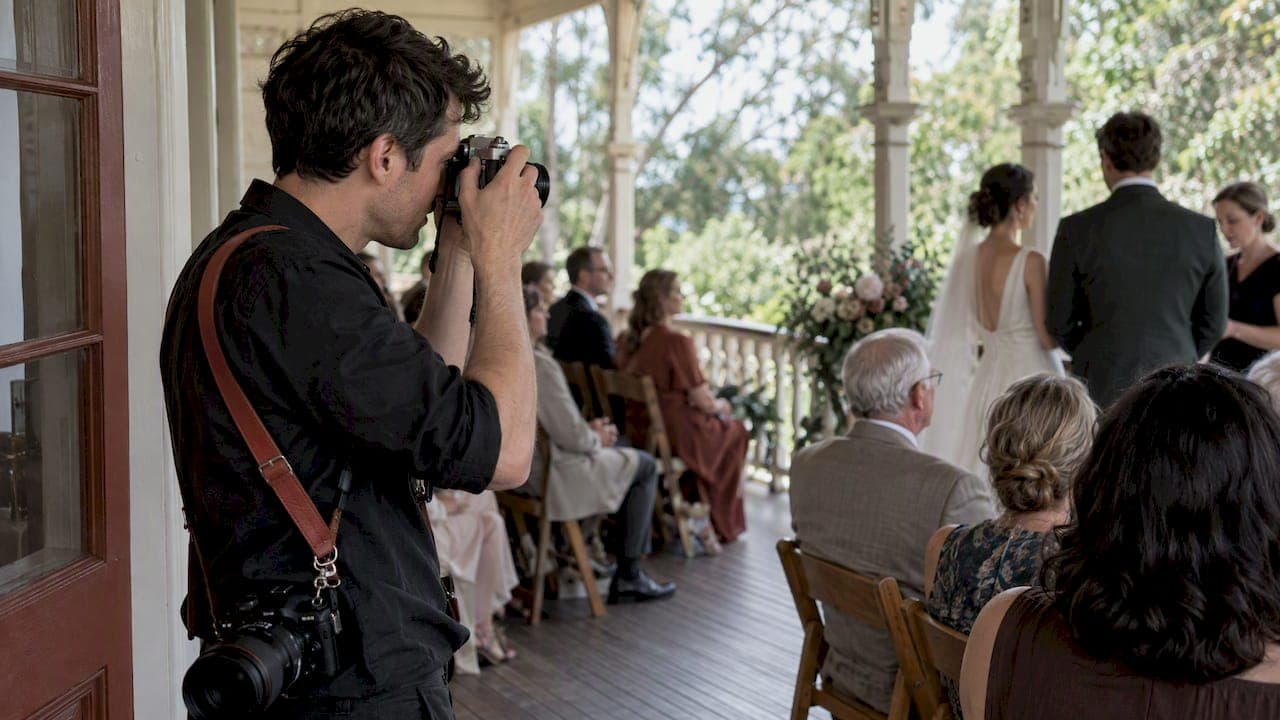
If you love soft colour, visible grain and a slower, more deliberate way of shooting, 35mm film wedding photography can be a great choice, and a hybrid film-and-digital package is a practical way to achieve it. Many couples choose hybrid coverage, pairing full digital reliability with some film rolls shot on stock like Kodak Portra 400 for texture and warmth.
TL;DR:
- A 35mm roll holds 36 frames, so reserve film for portraits, the ceremony, and golden hour; dim reception dancing is better covered digitally.
- In Australia, full day digital coverage typically costs $4,000 to $8,000, and film adds separate stock, lab processing, and scanning costs.
- Three or four rolls yield roughly 100 to 150 usable film exposures alongside digital coverage; ask how many rolls the package includes.
- Request a full wedding gallery across mixed lighting, then confirm the processing lab, scan resolution, file format, negative ownership, and delivery timeline in writing.
Table of Contents
- What 35mm film wedding photography looks and feels like
- Why couples choose film or a film-and-digital mix
- How hybrid film and digital wedding coverage typically works
- Practical logistics, costs and processing in-market
- How to choose a photographer for film or hybrid coverage
- Practitioner perspective: how a documentary-focused photographer uses film
- Examples of candid moments film captures differently
- Common challenges and limitations of shooting weddings on film
- How film shapes the mood and story of a wedding album
- Why we recommend hybrid film and digital coverage
- Booking with us: packages and next steps
- FAQ
- Sources
What 35mm film wedding photography looks and feels like
Film has a visual signature that's easy to recognise once you've seen it next to digital. Grain appears naturally in the shadows and midtones, highlights roll off softly instead of clipping, and skin tones carry a warmth that many couples find more flattering than a straight digital file.
Kodak Portra 400 remains one of the most popular wedding stocks because of its wide exposure latitude. Photographers can overexpose slightly to lift shadows and warm up tones while keeping highlight detail intact, which matters during a ceremony with harsh midday sun or a reception lit by fairy lights and candles.
- Grain and texture read as organic rather than noisy, especially in portraits and quiet in-between moments.
- Colour palettes lean warm, with muted blues and softened reds rather than the punchy saturation typical of digital.
- Highlights hold detail longer, which helps with tricky backlit shots during golden hour ceremonies.
Only about 7% of surveyed couples state film as their preferred wedding photography style, confirming it's a deliberate, niche aesthetic rather than a default choice.
Why couples choose film or a film-and-digital mix

Film appeals to couples who want fewer, more considered frames rather than thousands of near-identical shots. Because each roll holds a limited number of exposures, a photographer working on film tends to wait for the moment rather than firing off a burst, and that unpredictability often produces more intentional, emotive frames.
A hybrid approach solves the practical trade-off. Digital gives you volume and redundancy across the whole day, covering getting-ready chaos, the ceremony and dancing at the reception, while film is reserved for portraits, quiet moments and golden hour, where its tone and grain do the most work.
- Film encourages a slower, more deliberate shooting rhythm that suits portraits and quiet moments.
- Digital coverage provides the volume and consistency a full wedding day needs.
- Hybrid packages reduce risk, since a technical fault with one format rarely affects the other.
Market data backs up the "mix" instinct: candid and natural styles are preferred by around 44% of couples, with roughly 37% wanting a blend of traditional and candid work, and only 7% choosing film outright. Film is rarely the whole answer. It's usually the accent.
How hybrid film and digital wedding coverage typically works
Hybrid coverage isn't one fixed formula. Most photographers who offer it use one of a few common structures, depending on the couple's budget and how strongly they want the film look to show up in the final album.
- A handful of rolls added to a full digital day, often used during the ceremony, formal portraits and golden hour, with digital covering everything else.
- Film reserved for portraits only, giving couples a distinct, timeless set of images separate from the main digital gallery.
- A dedicated film second shooter, who works alongside the primary digital photographer to capture candid moments on film throughout the day.
A single roll of 35mm typically yields 36 frames, so three or four rolls across a wedding day gives a photographer somewhere around 100 to 150 usable film exposures to work with, alongside the full digital set. Once the day wraps, exposed rolls go to a processing lab for development and scanning before they're edited and delivered with the rest of the gallery, usually a few weeks after digital images are ready.
Practical logistics, costs and processing in-market
Adding film to a wedding package isn't free, and it's worth budgeting for it properly. Full-day wedding photography in Australia typically costs $4,000 to $8,000, with film usually sitting on top of that as an add-on rather than a standard inclusion.
Processing happens at specialist labs rather than in-house. Labs such as Irohas Photo and Fotofast use C-41 chemistry run through roller-transport processors, which keeps colour consistent across rolls, then scan negatives on Noritsu or Imacon equipment depending on the resolution and file format requested.
- Fotofast offers same-day developing and scanning for photographers wanting a fast turnaround on Queensland-shot rolls.
- Scan resolution and file format (JPEG versus TIFF) directly affect both image quality and processing cost.
- Negatives are returned as part of most lab packages, giving couples an archival copy independent of digital files.
The stock and lab combination you choose shapes the final look as much as the shooting itself. A warmer stock scanned at high resolution on Imacon equipment will produce noticeably richer files than a budget scan of the same roll, so it's worth asking your photographer which lab and scan settings they use before you commit.
How to choose a photographer for film or hybrid coverage
Not every wedding photographer who lists "film" on their website shoots it regularly or well. The best way to check is to ask for full, unedited galleries from real weddings shot on film, not just a handful of hero images pulled from a highlight reel.
- Ask how many rolls they typically shoot per wedding and what stock they prefer.
- Confirm who loads and handles the film on the day, and what their backup plan is if a roll is lost or damaged.
- Check which lab processes their film and what scan resolution and file formats you'll receive.
- Clarify who owns the physical negatives and whether they're included in your package or an added cost.
Before signing anything, get the delivery timeline in writing, since film takes longer to turn around than digital because of the lab step, and confirm whether extra fees apply for rush processing or additional scans.
Pro Tip: Ask to see a full wedding gallery shot in mixed lighting, not just a curated set of golden-hour portraits, so you can judge consistency across a whole day.
Practitioner perspective: how a documentary-focused photographer uses film
Charles shoots weddings as an observer first, waiting for real reactions rather than directing them, and film fits naturally into that approach. A few rolls are usually reserved for quiet, unscripted moments: a parent's reaction during the ceremony, a couple's private exchange at golden hour, the stillness just before the bridal party walks out.
Film doesn't replace the story a digital gallery tells across the day. It adds a handful of frames with a different kind of weight, the ones a couple tends to return to years later.
Digital carries the volume and pace of the day, while film is pointed at the moments that benefit from its softer tone and slower rhythm, particularly portraits and golden hour light.
— Charles
Examples of candid moments film captures differently
Some moments simply read differently on film, and it usually comes down to light and timing rather than posing. A grandparent wiping away tears during vows, caught in soft window light, tends to hold more warmth and less digital sharpness, which can feel more true to the moment as it was experienced.
Golden hour portraits are another case where film does distinct work. The warm, low light that often blows out slightly on digital sensors tends to hold detail on film, with the grain adding texture rather than noise. A couple walking away from their reception into last light, caught mid-laugh rather than posed, often becomes one of the more referenced images in a final album precisely because of that softness.
Quiet, in-between moments, a flower girl falling asleep during speeches, a best man adjusting his tie before the ceremony, benefit from film's unhurried shooting style too. Because a roll only holds 36 frames, a photographer working on film tends to wait rather than shoot continuously, which often means the frame that gets taken is the one worth keeping. These are rarely the images couples point to on their wedding day. They're usually the ones that matter most a few years on.

Common challenges and limitations of shooting weddings on film
Film has real limitations that are worth understanding before you commit to heavy film coverage. The biggest is exposure count: a roll holds 36 frames, so a photographer working purely on film has to be far more selective than one shooting digital, where thousands of frames are possible across a day.
Low light is another genuine constraint. Reception dancing under dim venue lighting is difficult on film without pushing the stock or using flash, which changes the look significantly compared to a bright ceremony shot in daylight. This is one of the main reasons photographers reserve film for ceremony, portraits and golden hour rather than the whole day.
There's also no instant feedback. Unlike digital, where a photographer can check exposure and composition on the back of a camera immediately, film results aren't visible until the roll is processed, sometimes weeks later. That delay means mistakes in exposure or focus can't be corrected on the day, which is part of why most photographers pair film with full digital coverage rather than relying on it alone.
Turnaround time affects couples too. Because film needs to go to a lab for processing and scanning, film images take longer to deliver than digital, and couples planning to use early photos for thank-you cards or social media should factor that delay into their expectations from the start.
How film shapes the mood and story of a wedding album
Film doesn't just change how individual photos look. It changes the rhythm of the album as a whole. A gallery that mixes digital volume with a handful of film frames tends to read like a story with both wide shots and quiet pauses, rather than a continuous stream of near-identical moments.
The warmth and softness of film naturally draws attention to the calmer parts of a wedding day: the quiet moment before walking down the aisle, a parent's expression during speeches, the stillness of a couple's exit at dusk. These frames tend to carry more emotional weight in a final album precisely because they look and feel different from the sharper, more immediate digital images around them.
Grain also plays a quiet role in mood. It softens skin and light in a way that feels closer to memory than to a crisp, clinical record of the day, which is part of why so many couples describe film images as feeling more timeless when they look back on their album years later.
Why we recommend hybrid film and digital coverage
We build film into wedding and elopement coverage as an addition to full digital packages, not a replacement for them, so couples get the reliability of digital across the whole day plus a set of film frames reserved for portraits, golden hour and quiet moments. Film sits as its own add-on within our pricing and packages, so you can decide how much of the day you want shot that way.
This approach keeps every important moment covered while still giving you the warmth and texture film is known for. If the look appeals to you, have a browse through our portfolio and come to an enquiry with your date, venue and how much film coverage you'd like included.
Booking with us: packages and next steps
Ready to lock in a date? Visit our pricing and packages page to see Signature Wedding, Essential Wedding, Elopement and film add-on options, or start with our weddings and elopements overview if you're still deciding on coverage length.

When you enquiry, include:
- Your wedding date and venue
- How many hours of coverage you're after
- Whether you'd like film included, and how much
We typically respond within a few business days with availability and a tailored quote.
FAQ
Is film wedding photography more expensive than digital?
Yes, film typically adds to the base cost of digital coverage rather than replacing it, since it requires separate stock, processing and scanning. In Australia, full-day digital packages commonly run $4,000 to $8,000, with film usually priced as an add-on on top of that.
How many rolls of film does a wedding photographer usually shoot?
It varies by photographer and package, but a few rolls spread across portraits, ceremony and golden hour is common. Each roll holds 36 frames, so three or four rolls gives a photographer roughly 100 to 150 usable film exposures alongside full digital coverage.
How long does it take to get film photos back after a wedding?
Film needs processing and scanning at a specialist lab before it can be edited, so it takes longer than digital. Turnaround depends on the lab and scan type chosen, with some Australian labs like Fotofast offering same-day developing, though full edited delivery still typically follows weeks after the wedding.
Do I need a photographer who only shoots film?
No, most couples are better served by a photographer offering hybrid coverage, pairing full digital reliability with select film frames for texture and mood. This gives you the aesthetic benefits of film without the volume and low-light limitations of shooting an entire wedding day on it alone.
What questions should I ask a photographer about film coverage?
Ask how many rolls they typically shoot, which lab processes their film, and who owns the negatives afterwards. It's also worth confirming scan resolution, file format and whether film images are delivered on the same timeline as digital or separately.
Sources
- How much does a wedding photographer cost? | Easy Weddings
- How Much Does a Wedding Photographer Cost in Australia? - Polka Dot Wedding
- Service – Irohas Photo
- Film Processing | Fotofast